Ask a room full of educators to describe the teacher who changed their life, and almost nobody mentions the syllabus.
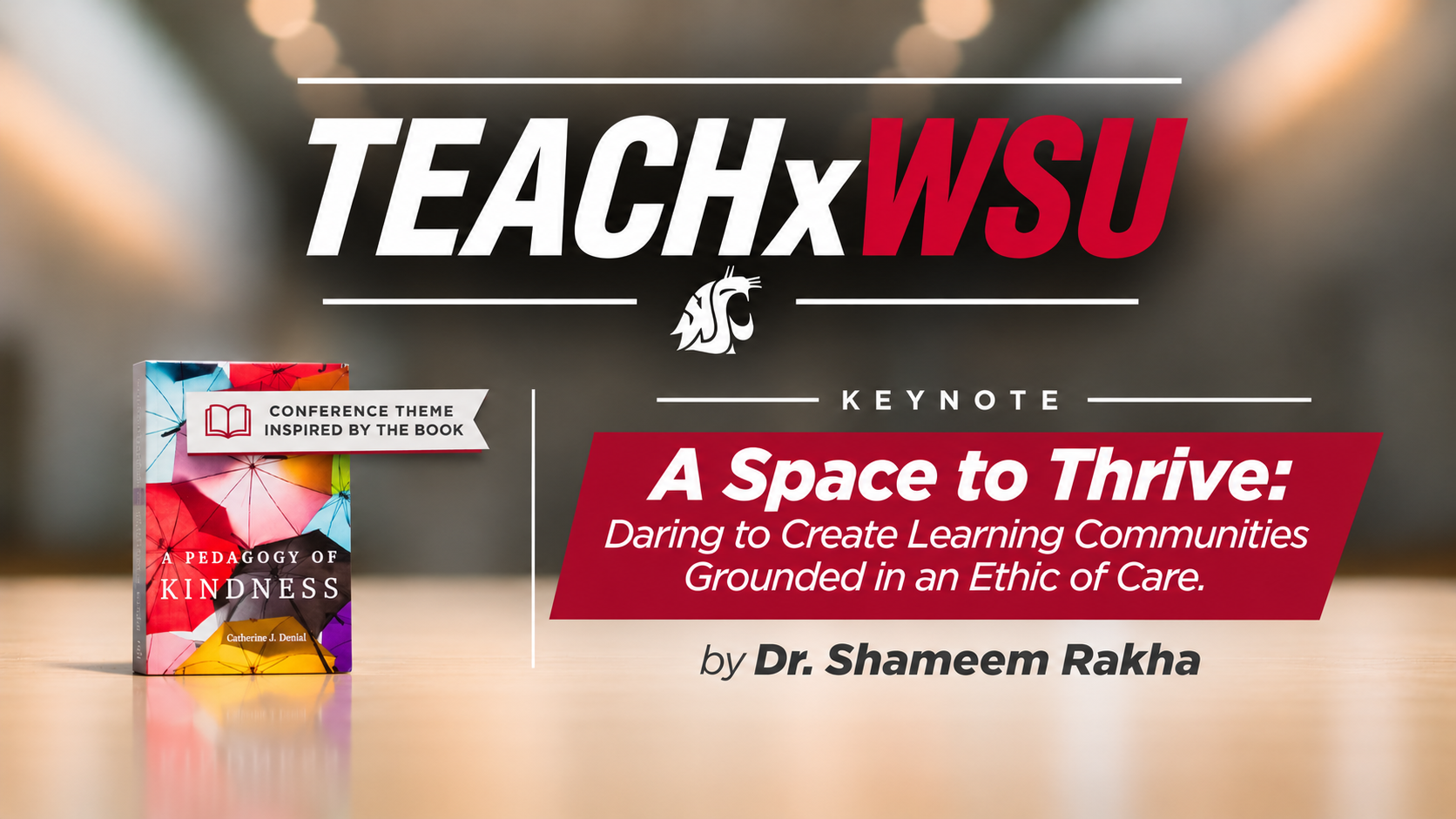
That was the opening move of Dr. Shameem Rakha’s keynote at the fifth annual TEACHxWSU conference on Sept. 25, 2026, and it set the tone for everything that followed. Rakha is a faculty member in the Department of Teaching and Learning in WSU’s College of Education, Sport, and Human Sciences and coordinates the BA in Education program at WSU Vancouver. She spoke to more than 100 faculty and staff gathered in Pullman and joining from campuses across the state.
This year’s theme, “Pedagogy of Kindness,” drew on Cate Denial’s book A Pedagogy of Kindness (read for free here). Rakha’s keynote, “A Space to Thrive: Daring to Create Learning Communities Grounded in an Ethic of Care,” made a clear argument. Care is not a soft add-on to rigorous teaching. It is the foundation that makes rigor possible.
The teacher you remember
Rakha asked attendees to picture “that” educator. Not necessarily the smartest or the best at delivering content, but the one who still matters years later. Then she had everyone enter three words into a live word cloud.
Kind, curious, compassionate, encouraging, attentive and funny filled the screen. Nobody wrote “great at writing rubrics.” Rakha has run the same exercise with students for years, and kind or caring almost always rises to the top.
Her own answer was her sixth-grade science teacher. Her tests were the hardest Rakha had ever taken, with scores posted on the back of the classroom door. Rakha studied harder than she ever had, not out of fear, but because she wanted to show she cared too. As an Indian kid in a predominantly white Chicago suburb, she often felt alone. That teacher noticed her and made her a leader.
“I became a teacher because of [her],” Rakha said.
Care is not the opposite of rigor
Rakha brings 35 years of teaching experience, from kindergarten through graduate school, including 12 years at WSU. She has heard every objection: care sounds soft, care is at odds with rigor, care means lowering the bar. She rejects that choice.
Learning requires vulnerability, she argued. We ask students to answer questions publicly, reveal what they don’t know, make mistakes in front of peers and risk failure. All of that requires trust. And trust grows when students feel known and, a word she returned to all morning, noticed.
“High expectations are an act of care,” Rakha said. The most caring educators she has known were often the most demanding, but they paired challenge with support. The caring message is not “this is too hard for you.” It is “I believe you can do this, and I’m going to help you succeed.”
Knowing who our students are
Today’s students are more diverse than at any point in the history of higher education. They are first-generation students, veterans, parents and working students. They are multilingual, transfer and returning students. Many are navigating disability, food insecurity or housing instability while carrying responsibilities their families have never had to navigate before.
“We cannot care well for students we do not know,” Rakha said.
She was candid that higher education was never designed to serve everyone. Recognizing that history, she said, isn’t about blame. It’s about understanding why some students still meet barriers others don’t, and why gaps in retention and graduation rates tell a story worth listening to. Many students quietly carry questions others never have to ask: Do people like me belong here? Am I college material? Do I matter?
Care is not the only answer, Rakha said, but it can be part of the answer. It can even be a lens for spotting barriers before they are built.
Her research in a community-run after-school program made the point vividly. One high school sophomore told her a tutor noticed when she’d cut her hair. At school, the student said, the only time a teacher noticed her was when she was being loud.
Care that empowers, not rescues
Rakha was equally clear about what care is not. She called out the Hollywood “teacher saves the kids” story and the savior mentality behind it. Care, she warned, can become paternalistic or controlling, and history is full of harm justified as being “for someone’s own good.”
Real care works alongside people. It invites rather than imposes. Rakha offered two questions every educator can ask: Am I helping students become more capable, or more dependent? Am I helping them find their voice, or speaking for them?
Care is also cultural. Rakha once interviewed a student whose professor routinely checked on her grades and missing work. To Rakha, it looked like textbook care. The student saw it differently: “That doesn’t show they care about me. That shows they care about my grades.”
The lesson stuck. Care has to be understood from the perspective of the person receiving it, not just the person giving it. Rakha tied it to her own parents, an immigrant father from Hyderabad and a mother born to German immigrants, who never once said “I love you.” Their love language was action and generosity. Hers, she admitted, is cooking. If you’ve eaten her jam or bread, you are loved.
What care looks like in a course
Care isn’t only about relationships, Rakha said. It lives in every pedagogical decision: whose voices appear in the curriculum, whether students have choices in how they show their learning, whether rubrics are clear and examples are shared, who gets heard in discussion, how group conflict is handled, how course policies are worded and what office hours are called.
She offered concrete moves any instructor can try:
- Learn names and say them correctly. Names communicate recognition.
- Notice absences. When a student misses class, Rakha emails to ask, “Are you okay? What support do you need?” She doesn’t cite the syllabus. In years of doing this, no student has taken it as permission to keep skipping.
- Build trust through consistency. Do what you say you’ll do, and own your mistakes when you make them.
- Treat students’ cultures and languages as assets. Multilingual students bring strengths, not deficits.
- Make mistakes expected. Fear suppresses learning. Psychological safety invites it.
The long arc of teaching
Rakha closed her talk with a story about Nate Wall, shared with his permission.
She met Nathan as a third grader at an elementary school in Urbana, Illinois. He did not sit. He bounced, darted and jumped. In a project-based classroom with rugs instead of rows, that was fine. When he was suspended once, Rakha and her class wrote him a letter. It wasn’t a scolding. It was a call-in, full of all the care a group of 8- to 10-year-olds could muster, telling him he was missed.
Years later, at 20, Nate gathered the teachers who had shaped him in a backyard and pulled out that letter. Rakha didn’t remember writing it, but he had kept it.
Today Nate is a teacher. Next May, he will become Dr. Nate Wall when he finishes his PhD in Educational Policy Studies at the University of Illinois Urbana-Champaign. At his wedding, Rakha learned that his bride had been one of 212 students in a course Rakha once taught. She had come to Rakha’s office while struggling, and whatever Rakha said helped her get the support she needed to stay in college.
“Very few professions allow us to witness the long arc of a human life,” Rakha said.
Caring without burning out
The Q&A turned to a question every caring educator eventually faces: how do you sustain this? Rakha admitted she’s still working on it. One change she made was to stop listening to the news.
Colleagues filled in with their own strategies. Set boundaries, such as reading email without answering it at all hours. Know your values and act in line with them; Erika Offerdahl, associate vice provost for faculty development and recognition, recommended Kristin Neff’s Fierce Self-Compassion. Build peer mentoring into a course so students care for each other, too. And know whether you recharge at a party or in your garden.
One faculty member who teaches 580 students this semester asked how relational care scales. Rakha didn’t sugarcoat it: in a very large lecture, you can’t know everyone, and she called that a flaw in the system. When she taught a 212-student course, she held a weekly coffee hour, and whoever came, came.
What students will remember
Rakha ended with a challenge. Educators can’t solve every problem students face or remove every barrier. But they do have the power to shape the spaces where they teach: classrooms grounded in dignity and belonging, where high expectations and humanity go hand in hand.
Years from now, students won’t remember every reading, lecture or lab. They’ll remember how their teachers made them feel. The word cloud from that morning said as much.
“We create these spaces when we care,” Rakha said.
Watch the keynote
Missed TEACHxWSU or want to revisit the talk? Watch the full recording of the event. Dr. Rakha’s keynote begins at about the 21:30 mark.