We’re proud of who we are and what we do. Whether you’re a student, alumni, or just support our mission, we love sharing our successes with you!
The Crimson Report report is released quarterly.
Winter–Spring 2026
One of the greatest privileges of this role is the opportunity to see, up close, the impact our students, faculty, and staff are making every day — on campus, across our state, and in the communities we serve. At Washington State University’s College of Education, Sport, and Human Sciences, our work is grounded in a simple idea: when we create opportunity, we change trajectories.
This quarter, I have watched that idea come to life in ways I will not soon forget.

A Quarter of Connection, Momentum, and Measurable Impact
If one theme defined this quarter across the College of Education, Sport, and Human Sciences, it was connection — between students and careers, research and practice, and community and opportunity. Those connections were not abstract. They showed up in a room of one hundred students trading questions with Seahawks and Kraken executives. They showed up in a federal grant that will expand inclusive postsecondary education for years to come. And they showed up in $90,327 raised by alumni and friends who believe in what this college does.
This was also a quarter of building. Behind the visible wins, CESHS advanced the less visible work that makes impact repeatable: a refreshed narrative and brand system, a new front door for college stories, a sharper retention strategy, and a leadership commitment to operate as one college rather than a collection of strong but separate parts. What follows is a closer look at the work — and the people — behind a quarter of measurable momentum.
Turning Access into Opportunity
WSU ROAR continues to do what few programs in the country can claim: it changes the trajectory of young adults’ lives at scale. The two-year inclusive postsecondary program serves students with intellectual and developmental disabilities — built on four words, Responsibility, Opportunity, Advocacy, and Respect — and immerses them fully in university life. ROAR Scholars live in campus housing, enroll in inclusive WSU courses, complete structured internships, and take part in the full rhythm of being a Coug.
The results set a national standard. Since 2018, seventy-five ROAR Scholars have come through the program, and the outcomes speak for themselves — especially against a national backdrop in which only 23.5 percent of adults with intellectual disabilities hold competitive, integrated employment.
This quarter brought both recognition and momentum. ROAR earned national attention for its model, and a $250,000 matching-gift challenge — known as Arshan’s Challenge — invited new supporters into the program. Every first-time gift to ROAR is matched dollar-for-dollar, directly fueling the program’s current work with students. A separate $2.8 million federal TPSID investment will help build out ROAR Pathways, extending the model further across the student journey.
That journey is about to grow. The college is developing three new pathways: Ready to ROAR, offering early college exposure and transition preparation for high-school students; ROAR Advance, a structured four-year pathway toward advanced credentials and specialization; and ROAR Beyond, providing up to a year of post-graduation support in employment, housing, and community integration. As recent graduate Aiden Fitzgerald put it, WSU ROAR is family — a bond, he says, unlike any other.
Learning Through Real-World Experience
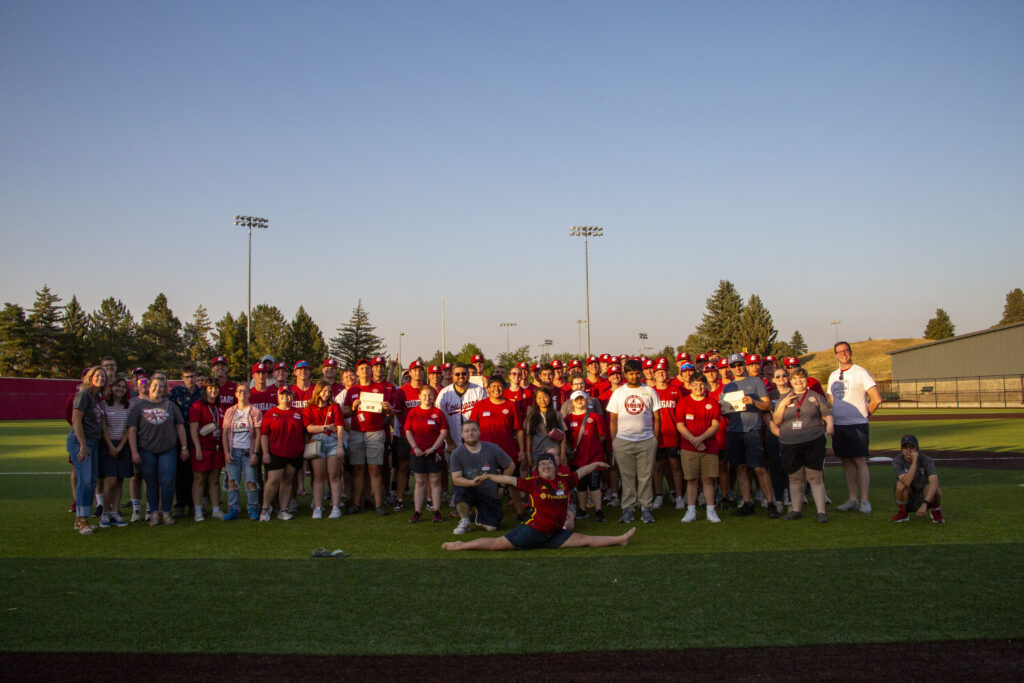
Experiential learning is not an add-on at CESHS — it is the model. Nowhere was that clearer this quarter than at the Insiders’ Huddle, where one hundred students connected with fourteen alumni and sport-industry professionals from organizations including the Seattle Seahawks, the Seattle Kraken, USC, and Everett Community College. For many students, it was a first direct line to the people who hold the jobs they are preparing for.
The Sport Management program turned that exposure into outcomes. Thirty-one students completed internships this year across an unusually broad range of settings — collegiate and professional athletics, media, sport tourism, the military, and community organizations — and the results show how well the program prepares them.
That is what it looks like when learning is active, applied, and connected directly to a career — and it is a pattern repeated across the college, where students graduate having logged hundreds of hours of real industry experience before they ever walk the stage.

Investing in What’s Next
A college that intends to lead cannot stand still, and this quarter CESHS made deliberate investments in its next chapter. The research enterprise is expanding quickly: faculty requested more than $36 million across fifty grant proposals for FY26–27, with a 35.6 percent success rate by dollars funded to date. Thirty-two faculty took part in two grant-development workshops this quarter, and eighteen are preparing proposals over the summer. By fall 2026, the college will house three research centers and more than twenty research labs — infrastructure that signals serious, sustained ambition. Guiding much of this is a vision the research office calls “Expanding the Circle”: widening the pathways into research and scholarship for faculty across every role.
The college is also expanding how and where students can learn. New and growing online offerings, stackable microcredential pathways, and global education partnerships are extending CESHS programs well beyond Pullman. Educational Leadership is redesigning its Ed.D. into a more accessible three-year online program and bringing it to WSU Global, while Sport Management advances a fully online, one-year master’s pathway. And in January 2026, the college formally established a new Department of Social Work, which has already cleared key accreditation milestones and will welcome its first BSW cohort in fall 2027.
Recognition, Research, and Academic Excellence
Recognition followed the work this quarter. Faculty and students earned honors across the college, from an Outstanding Publication award to the Sesquicentennial Practice Award earned by Holly Whittenburg, alongside two Big Ideas grants supporting community-engaged projects at the intersection of art, math, science, and climate. Graduate education remained a point of pride: the Teaching and Learning department alone awarded eleven PhD and ten EdM and MA degrees, while Educational Leadership graduated fourteen Ed.D., nineteen superintendent-program, and seventeen principal-program students.
Students claimed the spotlight as well. CESHS scholars presented at regional and national conferences and took part in research showcases such as the Three-Minute Thesis, where they translated complex work into clear, compelling ideas — exactly the kind of communication a modern research college should cultivate. Together, these moments reinforce CESHS as a place where rigorous scholarship and real-world relevance strengthen one another.
Building Community and Belonging
The college’s impact rests on a simpler foundation: students who feel seen, supported, and connected. That belief drives programs like Future Teachers in Community, which surrounds the next generation of educators with mentorship, shared experiences, and a sense that they belong here. It also shows up in the micro-communities woven throughout CESHS — cohort-based programs, research groups, and student organizations that make a large university feel personal.
This quarter, departments leaned into belonging intentionally. In Kinesiology and Educational Psychology, faculty introduced regular touchpoints and stronger connections among student groups, recognizing that retention begins with relationship. The college also deepened its ties to the surrounding community, including a CESHS and Pullman School District community breakfast that strengthened the partnership between the college and the schools its graduates will one day serve.
Telling the Story, Building the System
Great work deserves to be known, and this quarter the college invested in the systems that make its story easier to tell. The communications team led a deliberate refresh — refreshed narrative pillars and a clear public-facing tagline, Empowering Education, Advancing Sport, Enhancing Human Potential — and launched the CESHS Story Hub, a central front door where students, faculty, and program leaders can submit stories so they reach the people who can amplify them. Internal and earned media channels, including this Crimson Report and the Crimson Pulse newsletter, are running stronger as a result.
Underneath the storytelling is a larger commitment. At a leadership retreat anchored by three words — clarity, courage, and commitment — the college’s leaders began the work of becoming one college: not a collection of strong but separate programs, but a unified college that operates, communicates, and holds itself accountable as one. That work will produce a shared One College operating statement, an updated brand narrative, media training for leadership, and a refreshed media kit in the quarters ahead.
A Community That Invests
None of this happens alone. During CougsGive 2026, the CESHS community raised $90,327 — gifts that translate directly into scholarships, programs, and the kinds of student experiences this report describes. That generosity arrived alongside the $250,000 matching-gift challenge for WSU ROAR and a donor pipeline increasingly focused on scholarships, experiential learning, and faculty support. Each gift is a vote of confidence in the college’s mission, and a reminder that the work CESHS does matters to people far beyond campus.
The Throughline

Students to careers. Research to practice. Community to opportunity.
That is what a land-grant college does, and it is what CESHS does — connecting the work of the classroom and the laboratory to the lives of real people across Washington and beyond. Every story in this report is a different expression of the same commitment.

Looking Ahead
The momentum of this quarter points toward an ambitious year. CESHS will continue expanding access through online and global programming, deepen its leadership in AI-enabled education and human-sciences research, and carry the One College commitment from the retreat room into daily practice. The college does this work against a real backdrop of budget pressure and a shifting funding landscape — but it does so the way it always has: by keeping students at the center, investing in its people, and turning opportunity into impact.
Empowering Education · Advancing Sport · Enhancing Human Potential
Fall 2025
The fall semester brings Sport Management’s 40th anniversary. To celebrate this, the College of Education, Sport, and Human Sciences wanted to put an extra focus in this Crimson Report on highlighting the Sport Management program, its people and their successes, and the foundation the program had on them. Plus highlight a fun event Sept. 5-6.

Chuck Arnold, President of the Seattle Seahawks, is an alumnus of the Sport Management program and will be the keynote speaker for the 40th Anniversary celebration.

Spring 2025
Our dean Karen Thomas-Brown shares her message of our college progress, even during perilous times. We take a look at one stellar student, one amazing alumnus, a great WSU ROAR scholar, and top-notch faculty member. We share news from various campuses as well as the departments. And we highlight a few things coming up!
Winter 2024
In her first Crimson Fire message, Karen Thomas-Brown reflects on Thanksgiving and Giving Tuesday and the gratitude to everyone who contributes to the vitality and mission of our college. We introduce you to some of the people of whom we are so proud. We also share some of our news and events.

Crimson Report launched in Winter 2024 as a quarterly publication, replacing Education News, the college’s e-newsletter of 13 years.